

Pulmonary balloon valvuloplasty
Learn what the procedure involves, how hospitalization proceeds, and what the treatment outcomes are.
Detailed information regarding qualification, surgical technique, and collaboration in patient management.
Pulmonary valve stenosis
Pulmonary valve stenosis is a congenital heart defect that impairs normal blood flow from the right ventricle to the lungs. The severity of the narrowing can vary—from mild, asymptomatic forms to severe cases requiring urgent treatment. In more advanced cases, symptoms such as exercise intolerance and fainting may occur. If left untreated, the defect can lead to right ventricular heart failure, ascites, and in extreme situations, it may become life-threatening for the patient.
In this condition, there is no effective pharmacological treatment that can eliminate the cause of the narrowing. The primary method of correcting the defect is pulmonary balloon valvuloplasty—a minimally invasive percutaneous procedure.
What does the balloon valvuloplasty procedure involve?
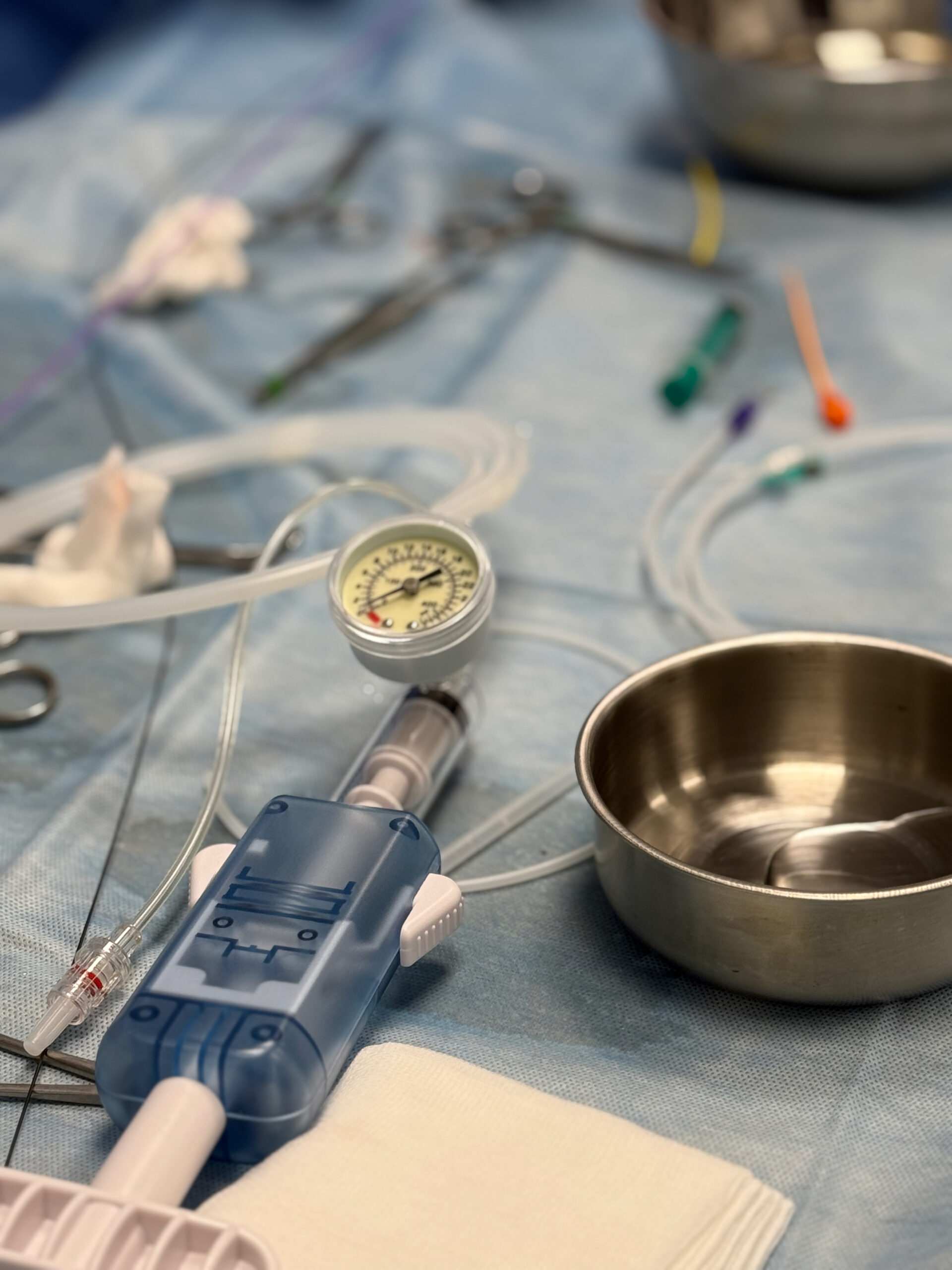
Pulmonary balloon valvuloplasty is a minimally invasive percutaneous procedure. It involves puncturing the skin and inserting a catheter through a vein, with a balloon at its tip. Once positioned within the narrowed valve, the balloon is inflated, which leads to widening of the valve and improved blood flow. The aim of the procedure is to reduce the severity of the defect.
Pre-operative assessment and interview with the owners
On the day of the procedure, a repeat echocardiographic examination is performed, followed by a detailed consultation with the owners, including pre-anesthetic evaluation.
Pre-operative preparation and induction of anesthesia
Prior to the procedure, the patient's neck and chest areas are shaved. Intravenous catheters are placed, and an experienced anesthesiologist induces general anesthesia. Defibrillation pads are positioned on the chest in case of life-threatening arrhythmias. The patient is then connected to advanced monitoring equipment to continuously track vital signs.
Obtaining vascular access
The first stage of the procedure involves puncturing the external jugular vein with a needle and placing a vascular access port, through which a balloon catheter is introduced.
Ventriculography – right ventricular contrast study
The next stage involves injecting a contrast agent into the right ventricle, near the stenotic valve. This allows for X-ray visualization of the surgical site.
Balloon valvuloplasty
A balloon catheter is advanced to the area of the stenotic valve. Once properly positioned under fluoroscopic and transesophageal echocardiographic guidance, the balloon is inflated several times to a high pressure of over a dozen atmospheres. Following the inflation, the balloon catheter is removed, and the outcome of the procedure is evaluated via a repeat contrast study and 4D transesophageal echocardiography.
Final steps of the procedure
The vascular access sheath is removed from the jugular vein, and manual pressure is applied to the wound for about fifteen minutes until hemostasis is achieved and bleeding stops. In some cases, a few sutures may be required to close the wound. The patient is then recovery-awakened from anesthesia.
How is a patient qualified for the procedure?
From the owner's perspective
From the owner's perspective, the qualification process for pulmonary valve balloon valvuloplasty primarily involves a consultation with a veterinary cardiologist and a cardiac ultrasound (echocardiogram). Based on these, the severity of the valve stenosis and the impact of the defect on heart function are evaluated. The owner receives detailed information regarding the indications for the procedure, how it is performed, as well as the potential benefits and risks.
For referring veterinarians
Coming soon..
Frequently Asked Questions
The exact scope of required blood work is determined individually before the procedure; however, it typically includes a complete blood count (CBC), a basic biochemistry panel, and a coagulation profile.
Unfortunately, under Polish law, we are not permitted to publish pricing for our services online. To obtain information regarding estimated procedural costs, please contact us via email.